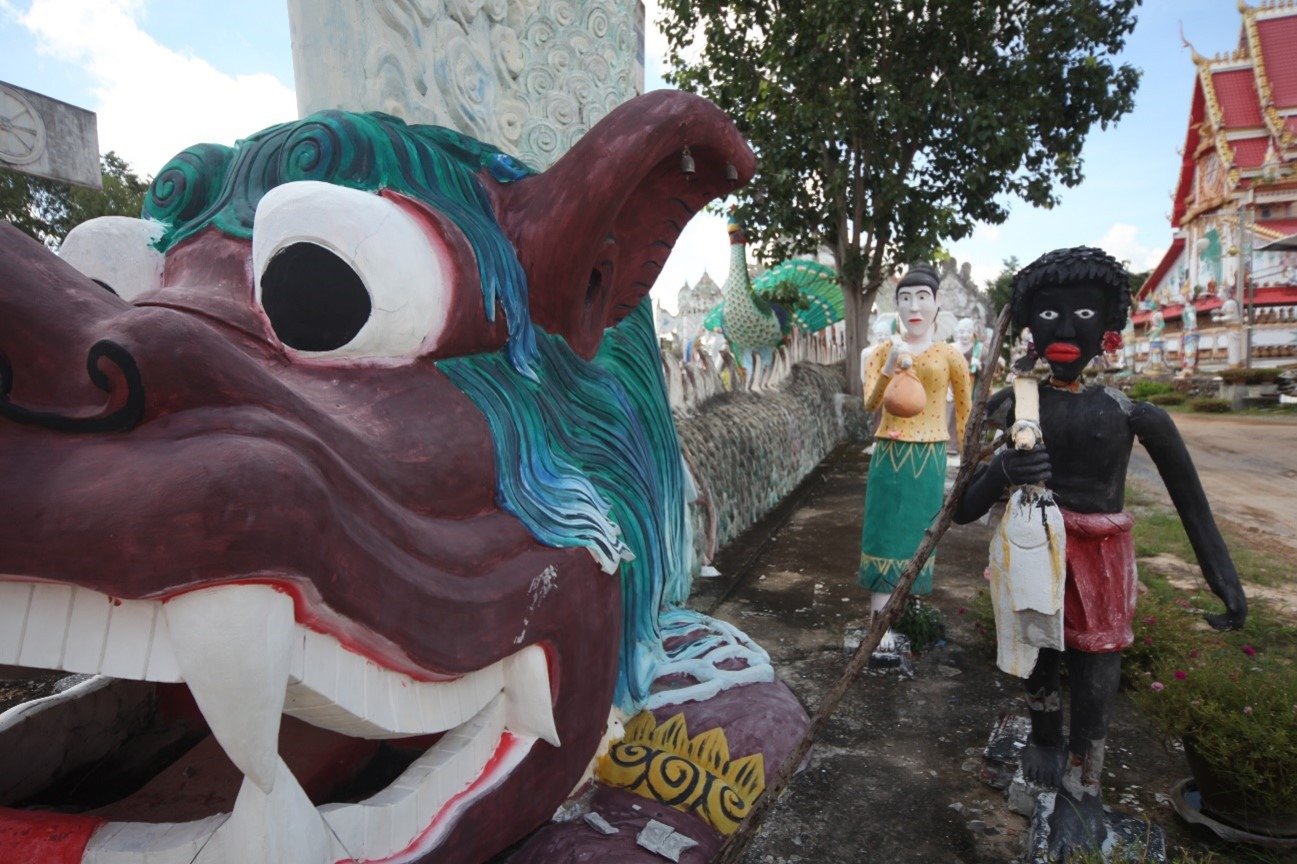
Wat Pa Non Sawan in Thoet Thai, Thung Khao Luang district, is the Roi Et temple also known as Wat Mo, or the pot temple. Its pottery decoration and sculpture make it a different kind of stop from a conventional gilded relic chedi. Come prepared to look closely at individual scenes and the temple’s village context, rather than expecting a polished museum with a fixed exhibition route.
Choose the Roi Et temple with the correct full location
The local-government tourism page identifies Ban Thoet Thai and the Thung Khao Luang district address. The temple also appears as Wat Pa Non Sawan, Yang To, in a provincial public-relations account. These names help identify the intended place when a driver or a map offers several similar results.
There are other temples called Wat Pa Non Sawan, including one in Kalasin. The name alone is not a reliable destination. Use the Roi Et province, Thoet Thai subdistrict and the pot-temple association together when arranging the visit.
The location is separate from central Roi Et and from the mountain chedi at Chai Mongkhon in Nong Phok district. A provincial hotel can support either trip, but a shared province does not turn them into adjacent stops. Plan the road approach according to your actual starting point and next destination.
Why pots belong in the architecture
The tourism directory and local authority both describe the use of clay pots made by local villagers as part of the temple’s decoration. The nickname Wat Mo refers to that material choice. It is worth noticing how repeated objects become part of a larger surface, rather than treating the pots as unrelated ornaments.
Look at a broad section first, then examine the repeated forms from a permitted close position. This gives a different reading from photographing only the largest sculpture. The relationship with local pottery is a particular reason for including this temple in a cultural trip.
The temple’s decoration is sometimes compared visually with Khmer and Indian art, but that comparison should not be turned into a precise historical attribution for every figure or building. The materials and the religious storytelling are clearer starting points than assigning a style solely from appearance.
Read the sculptures as moral and religious scenes
Official visitor descriptions mention a Hanuman-mouth entrance, giant turtle forms and paintings concerning the Buddha within the multi-level central structure. The outdoor sculptures are described as carrying moral teachings. Their unusual appearance does not make the temple an amusement park.
Consider each scene before taking a photograph, and let worshippers and temple activity determine where you stand. A visitor interested in Buddhist imagery may find the variety more useful than an attempt to see every figure in a set order. No official English-language interpretation tour has been verified.
Families should decide how much attention to give individual scenes rather than assuming every sculpture has the same tone or meaning. Following the route available on the day is more appropriate than making up a complete explanatory narrative from an unfamiliar figure. Ask a knowledgeable local guide when interpretation is important.
An outdoor visit and an interior visit need different checks
Much of the interest described in the visitor information is outside, but references to interior paintings do not prove that every floor is open throughout the day. Ask which areas can be entered before building the visit around the upper levels of the central structure.
For someone who needs to avoid stairs, establish what is reachable at ground level and where a vehicle can stop. A broad outdoor compound does not confirm smooth surfaces or access into every building. There is no complete operational wheelchair route or lift specification verified here.
Daylight is the editorial preference for seeing the pot decoration and varied sculptural details. The available directory timetable is not clear enough to promise a reliable current opening period, so confirm the intended visiting time locally, particularly before arranging a long detour.
A working community temple, not a static attraction
Roi Et’s provincial public-relations office reported a ceremony here on 18 December 2025 honouring former abbot Luang Pu Khamphan Chanthachoto. That dated account confirms continuing religious and community use; it is not a programme for a future ceremony or evidence that access is unchanged every day.
Allow the temple’s activities to take priority over a photographic route. If a space is reserved for a service, spend time with another public part of the grounds rather than trying to continue through it. This is particularly relevant at a place whose visual interest can otherwise encourage visitors to treat every surface as an exhibit.
Build a realistic Roi Et day around your interests
A sculpture-focused outing here can be combined with another stop only after checking the road relationship and the available time. Chai Mongkhon offers a useful contrast in scale and form, but it is a separate district excursion rather than the next courtyard.
Choose a hotel for the whole Roi Et chapter and agree the temple journey separately. If transport time is limited, a careful visit to one place is more useful than a list of distant temples reached only briefly. The practical goal is to understand this distinctive pot-decorated temple without confusing its location or its religious role.
Sources & visiting details
Sources checked on 29 October 2026. Visiting limits and conflicting published details are explained in the guide.