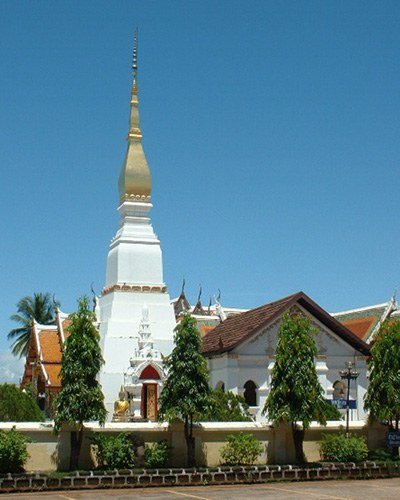
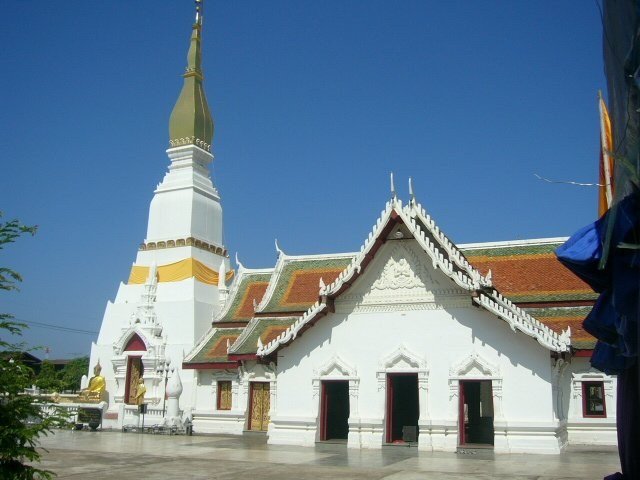
Wat Phra That Choeng Chum is a central Sakon Nakhon visit where the white chedi and the hall containing Luang Pho Phra Ong Saen belong together. The sacred story concerns the footprints of successive Buddhas, while the archaeology points to an older sanctuary within the later monument. Looking at both gives the visit more substance than stopping only for the chedi’s outline.
Keep the religious tradition and the archaeology distinct
The Fine Arts Department explains Choeng Chum through the Urangadhatu tradition, in which the location received the footprints of Buddhas. It discusses that sacred account alongside the older, stone-sanctuary-like structure and an inscription. The tradition explains why people venerate the site; it is not a reason to assign a precise construction date to every visible part.
The same department describes the later influence of Lan Xang Buddhism and the continued importance of the monument. A useful way to read the compound is as a place repeatedly maintained and reinterpreted, rather than a single building from one moment. The exact founding date is not securely established in the municipal description.
The restrained white tower and the older structure inside
Sakon Nakhon municipality describes a brick-and-stucco chedi on a square base, with a plain lotus-shaped upper section and a golden umbrella. Its relatively restrained surface differs from heavily gilded or densely sculpted temples elsewhere in Isan. Look first at the proportions and the transition from the base to the narrow upper portion.
The municipal account identifies an eastern entrance and false-door treatment on other sides, with older laterite and red sandstone construction within. That archaeological description does not guarantee unrestricted visitor entry inside the monument. Follow the actual access signs and observe the tower from the permitted areas if an opening is closed or used for worship.
Make room for the Buddha image and the smaller structures
The nearby hall houses Luang Pho Phra Ong Saen, a revered seated Buddha image. This is a separate focus of devotion from the chedi itself. Visitors should avoid treating the hall merely as an indoor shortcut between photographic positions.
The municipality also documents an older sim, the local term for an ordination hall, a sacred well surrounded by naga sculpture and a three-level bell or drum tower associated with the local Vietnamese community. These elements show how the temple’s life extends beyond its main tower. Access to each may vary, so read an architectural inventory as things to ask about rather than a guarantee that every door is open.
A city visit with religious activity at its centre
The temple is on Rueang Sawat Road in That Choeng Chum subdistrict, within Sakon Nakhon city. It therefore fits a city-based stay more naturally than a remote hill-temple excursion. Check the hotel’s actual road location before deciding whether the temple approach is convenient for your group.
A visit can be paced around the chedi and the main hall, followed by a closer look at the smaller structures that are accessible. This sequence is an editorial suggestion rather than an official ritual route. At busy worship times, allow the people using the site for devotion to set the pace.
Clothing covering shoulders and knees and shoes that are easy to remove are practical for moving between the courtyard and religious rooms. Do not point a camera into private activity, cross a cordon or touch the older fabric simply because it is within reach.
Festival information and the limits of an ordinary listing
The municipal account describes an annual worship festival associated with the lunar calendar, as well as evening worship on Buddhist observance days. Those patterns should not be converted into a future Gregorian-date promise without that year’s announcement. A ceremony-focused trip needs the current programme before a room or vehicle is chosen around it.
No reliable current all-building opening schedule or admission tariff is established here. Plan the first visit in daylight and confirm any particular interior or evening activity that matters to you. A temple compound being open does not mean an older hall and shrine interior all share the same conditions.
The appeal here is the relationship between a living city shrine, a sacred footprint tradition and the older sanctuary embedded in the later tower. Giving those elements separate attention makes a focused Sakon Nakhon stop more useful than trying to reproduce a long regional circuit in one afternoon.
Sources & visiting details
Sources checked on 29 October 2026. Visiting limits and conflicting published details are explained in the guide.